A consortium brings together partners who, more often than not, would never have chosen one another. A capital-intensive energy or infrastructure project calls for sums that no single player is willing, or able, to commit alone. Resources are therefore pooled, costs shared, expertise combined and risk spread. The structure makes obvious economic sense. What it seldom produces is governance equal to what is at stake.
Under French law in particular, a consortium has no legal personality of its own. Everything rests on the agreement: the allocation of investment and revenue, decision-making mechanisms, dispute resolution, the responsibilities of each party. The potential of a venture, whether measured in revenue or in earnings, can be wiped out by poorly designed governance. Before signing up, each partner should subject the others to the scrutiny it would reserve for an acquisition target. Four factors drive the risk.
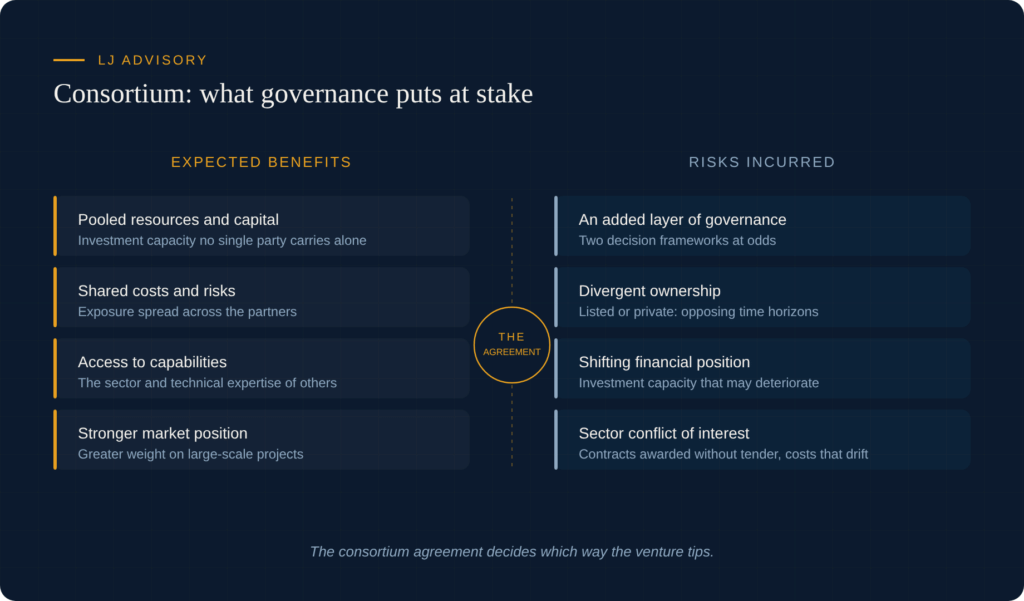
An added layer of governance. Each company arrives with its own rules, its own processes, its own decision-making model. The consortium, for its part, sets out no more than a broad framework. In practice, every decision is therefore assessed twice: at consortium level, then against each partner’s internal standards. Misalignment between these frameworks is the rule, not the exception. To move forward, a partner will sometimes knowingly step outside its own procedures. It then falls to the lead partner to advocate for the decision and explain it. Without buy-in, deadlock sets in: bespoke rules have to be designed, for procurement or for engineering, and the drafting and approval of procedures specific to the consortium soon becomes a considerable undertaking.
The nature of the shareholding. A listed company and a privately held one do not assess the same project against the same yardstick. The first, bound by short-term return requirements, reasons in conventional metrics: earnings, net present value, internal rate of return. To it, a euro received today is worth more than a euro received tomorrow, through the effect of discounting, and it will commit whatever means are needed to meet that horizon. The second, shielded from market pressure, allows itself an altogether different management timeframe, less beholden to cash-flow forecasts and to the macroeconomic assumptions of a point-in-time valuation. Around the table, the two clocks do not keep the same time, and the disagreement bears on the very variables of the project.
The partners’ financial position. At signing, each party gave assurances as to its investment capacity. Yet the business plan and accounts of each party have rarely been examined with anything approaching the rigour of due diligence. And a financial position shifts over time. How the venture’s income is allocated weighs heavily here: depending on whether a partner sets it aside for future investment in the project or uses it to fund other entities within its group, its strategy changes course and execution is weakened. What was secured at signing is not necessarily still secured halfway through.

The sector of origin. The partner whose business lies closest to the purpose of the project has the firmest grasp of its execution risks. That advantage cuts both ways: it will seek to secure the contracts that fall within its own field, and every decision turns into a negotiation conducted on a give-and-take basis. Any departure from a neutral tendering process then translates into cost overruns for the others, or even into quality shortfalls where the credentials of the best-value bidder had been overstated. At the other end of the spectrum, the partner least familiar with the sector discovers the risks along the way. A financial investor operating outside its usual territory depends on a third party to assess the risk-return trade-off; faced with a technical question, its indecision is paid for in a prolonged mobilisation of project resources. The least qualified partner sets the pace for everyone.
What truly protects: the agreement. These four risks share a common denominator: they are neutralised upstream, in the agreement, or not at all. The scope of investment and activities must be given binding legal force there. An investment schedule, the terms on which its scope may be revised, the commitments made by each party: once formalised, they hold the project to its original design; left to goodwill alone, they open the door to minimal investment, and to returns below plan whenever the parties are ill-matched.
The lesson fits in a single sentence. In a consortium, the primary risk is neither technical nor financial: it is one of governance, and it is decided before the first euro is invested. Subjecting one’s partners, their governance, ownership, finances and business, to the same scrutiny as the asset itself is not an optional precaution. It is the condition for the venture to deliver on its promise, and it lies at the heart of our work in capital allocation and strategy ahead of complex transactions.